-
Opere
-
Sienese Middle Ages
Sienese Middle Ages
Madonna of Crevole by Duccio di Buoninsegna. Author's copy by Silvia Salvadori.
Sacred icon made with tempera and pure gold on wood.
Work performed with the ancient pictorial techniques of the Sienese school of the fifteenth century.
32 x 44 cm

Holy gold tempera icon. Reproduction of art by Duccio di Buoninsegna (painting by Silvia Salvadori - Bottega d'Arte by Silvia Salvadori - Arezzo). Work performed with the ancient pictorial techniques of the Sienese school of the fourteenth century. Icon of the Madonna and Child (author's copy of the Madonna di Crevole by Duccio di Buoninsegna, Siena) painted in tempera and pure gold on an ancient table according to the ancient recipes of the Sienese school. Art reproduction of the Madonna di Crevole by Duccio di Buoninsegna. The table comes from the church of Santa Cecilia in Crevole; on the basis of a series of indications, it is believed that the table was made for the church of Montepescini and then passed to the Augustinian hermitage of Montespecchio. This youthful masterpiece by Duccio di Buoninsegna should be considered in comparison with the Madonna di Castelfiorentino di Cimabue. Given the strong iconographic affinity, it is very likely that the Madonne di Crevole and Castelfiorentino were performed in very close times, almost competing with each other. In fact, the first is the work of a Duccio di Buoninsegna very close to Cimabue, while the second shows us a sweetened Cimabue, following the engaging relationship, with the young Duccio di Buoninsegna. There is in the Madonna di Crevole, a perfection in design, composition and expression that make it an admirable masterpiece. The big eyes are busy watching the viewer intensely, inviting them to meditate on the tragic fate of their child. The execution is of such finesse that the thin parallel strands that modulate the chiaroscuro according to an artisan elaboration dating back to Cimabue are hardly seen. The pink fleshiness of the Child is enhanced by the very light garment that veils it and which, together with its small coat, obtains the results of a mobile and almost liquid transparency, of an unusual finesse. One of Cimabue's novelties with respect to the Byzantine pictorial tradition was the great executive care; but Duccio di Buoninsegna goes further, towards a refinement to which even the great Florentine painter had never arrived. In Duccio di Buoninsegna's work, everything is muted and internalized. A solemnity and an intense pathetic sweetness emanate from the arcane cloak, from the great eyes of Mary.
Siena, Museum of the Opera del Duomo - art reproduction by Duccio di Buoninsegna
Painted on a gold background. Pure gold 23 k. Egg tempera, fine pigments. Ancient wooden board. Use of the same original painting technique used in the 14th century.
Reproduction of art by Silvia Salvadori, gold background icon, Sienese school painting. The haloes were engraved and decorated (gold on gold) with elegant designs of flowers.
Crucifixion by Duccio di Buoninsegna
Off
Sienese Middle Ages
Icon of the Madonna and Child. Reproduction of Art by Silvia Salvadori.
Sacred icon made with tempera and pure gold on wood.
Work performed with the ancient pictorial techniques of the Sienese school of the fifteenth century.
59 x 40 cm


Madonna and Child by Silvia Salvadori. Art Workshop of Silvia Salvadori - Arezzo. Medieval painted boards. Work drawn from: Pietro Lorenzetti, 14th century. Technique: tempera and gold on wood. ART REPRODUCTION by Silvia Salvadori. Icon of the Madonna and Child painted in tempera and pure gold on an ancient table according to the ancient recipes of the Sienese school. Icon. Madonna and Child, art reproduction by Pietro Lorenzetti. Medieval art. Polyptych of the Pieve di Santa Maria, Arezzo. Pietro Lorenzetti (Siena, ca. 1280/85 - ca. 1348) was an Italian painter of the fourteenth century, one of the painters of the Sienese painting school. He was the older brother of Ambrogio Lorenzetti. His training had to take place under Duccio di Buoninsegna, with the same age as Simone Martini. From 1310 to 1320 he participated in the large decorative construction site of the Lower Basilica of Assisi, with Simone Martini and other Florentine painters from Giotto's school; in particular he worked in the south transept in the service of Cardinal Napoleone Orsini, frescoing scenes from the Passion of Christ, in which he demonstrated that he had developed an autonomous figurative language that synthesized Sienese art and Giotto's language. For example, the scene of the Last Supper is emblematic, built around a table beneath a magnificent hexagonal loggia (which is very reminiscent of the structure of the pulpit of the Cathedral of Siena by Nicola Pisano), where the assimilation of perspective techniques is demonstrated for the virtuous architectural settings derived from Giotto; but even more surprising is the vision of the narrow room of the servants on the left: a quarter of the surface of the fresco is in fact occupied by the adjacent kitchen, where food is boiling over a hearth and two servants clean the dishes and throw the leftovers; in the background you can recognize details of the furniture (a coal shovel and shelves with dishes) and in the foreground we find a cat that warms itself by the fire and a dog that licks the leftover food from the dishes. No Giotto follower would probably have considered a detail worthy of "low" as it is everyday, while Pietro Lorenzetti's curiosity appears to be lit by this meticulous detail, by the precise description of reality. The polyptych of the Madonna della Pieve of Arezzo from 1320 is the first dated work to date. Pietro Lorenzetti later went to Siena, where in 1329 he painted the great icon of the Madonna and Child, San Nicola di Bari, Elia and Angeli or Pala del Carmine, as it is still preserved in the Sienese church of Carmine. The Madonna is seated on the throne, in a solemn plasticity reminiscent of Giotto's Madonna di Ognissanti, especially in the full-bodied shades of the face. Of this work is also interesting the tablet with the fountain of the prophet Elijah, part of the predella, in which he is a Carmelite who draws water with a jug. Pietro Lorenzetti's sensitivity for the material quality of the natural elements and for their optical effects is made evident by the rippling of the water surface of the tank due to the splashing effect and by the reflections on the glass bowls resting on the edge of the fountain. Also in Siena, together with his brother Ambrogio Lorenzetti, he painted the now lost frescoes on the facade of the Hospital of Santa Maria alla Scala in 1335. In more mature works he appears influenced by his brother Ambrogio Lorenzetti, where the most Florentine Giottoism is diluted in naturalistic and luministic research. For example, in the triptych of 1342 for the cathedral of Siena, intended to decorate the altar of San Savino, he represented the Nativity of the Virgin on three panels treating them as if it were one, indeed treating the demarcations as if they were the pillars that separate the room in three rooms, two of which belong to the main room and one, on the left, where Joachim, Maria's father, is anxiously waiting. The painted vaults are illusionistically placed on the "pillars" of the frame and their perspective follows a precise system of orthogonal planes also in depth (see for example the breakthrough on a porticoed courtyard on the left), which present angles very close to those of the true perspective Unified vanishing point geometry prepared only by Brunelleschi at the beginning of the 15th century. The domestic interior, however, is not reduced to a cold architectural structure, on the contrary the figures move at ease and the details of furniture and furnishings are well-kept, from the floor tiles to the little stars painted on the cross vaults. This is also the last documented work by Pietro Lorenzetti, of which there is no more news after 1347: it is probable that he died during the plague of 1348.
Arezzo, Pieve di Santa Maria - Reproduction of art by Pietro Lorenzetti
Tempera and pure gold on an ancient table
Reproduction of art by Pietro Lorenzetti (Arezzo, Polyptych of the Pieve di Santa Maria). Art Workshop of Silvia Salvadori - Arezzo. Medieval painted boards.
Off
Sienese Middle Ages
Icon of Virgin Mary with the Child in Throne.
Art Reproduction from Lippo Memmi (1320-1322 approx.)
Sacred icon made with tempera and pure gold on wood. Work executed with the ancient pictorial techniques of the Sienese school of the fifteenth century.
12 x 17 cm
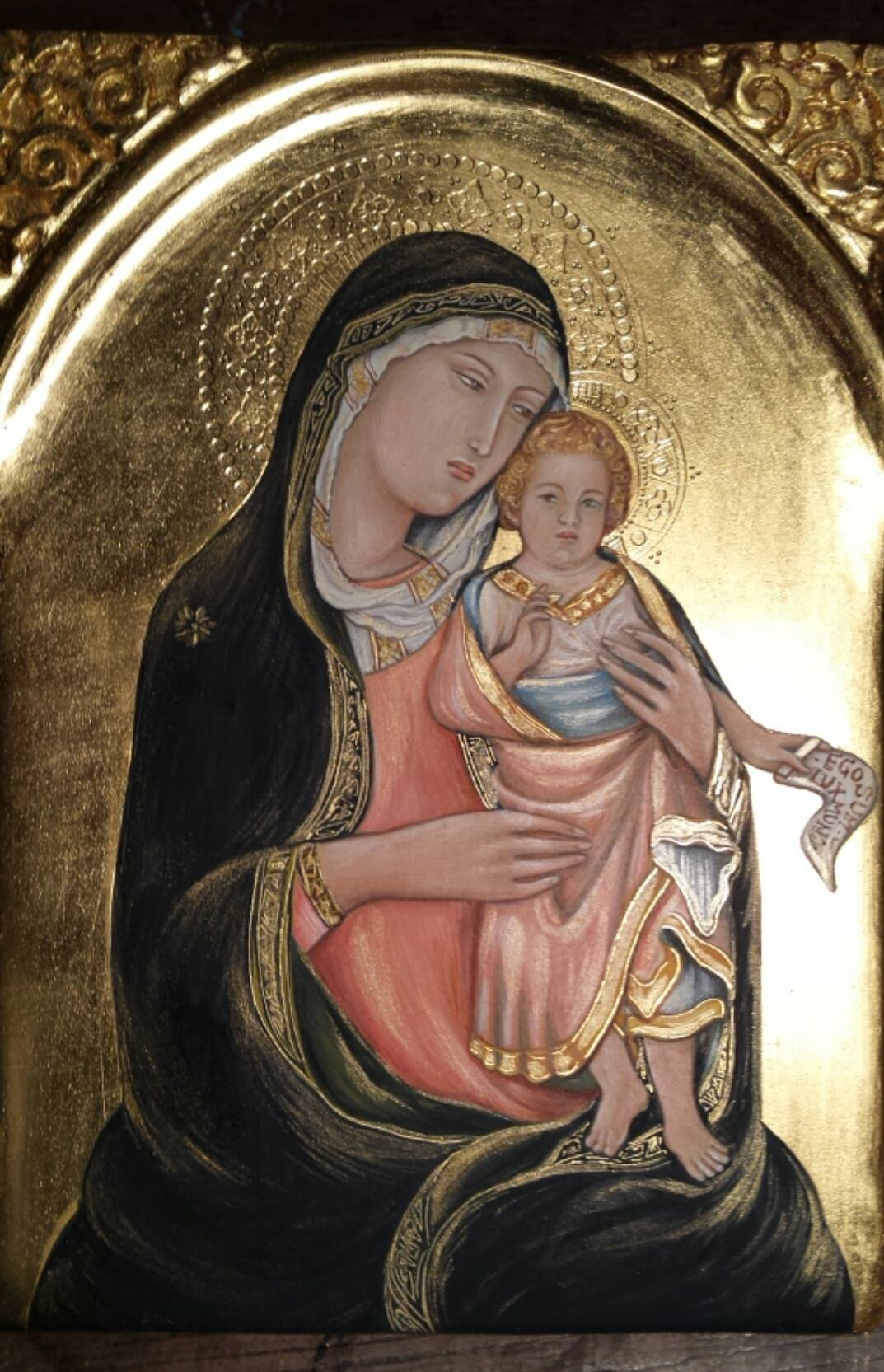


The Virgin, represented in full figure, is wearing a pink tunic and a large blue mantle, listed in a gold embroidered hem (gold plated 23k powder), which also covers her head. It is sitting on a high backrest throne, completely covered with golden brocade decorated with plant motifs. In the repertoire of the precious fabric, the lining of the ermelline is intersected. Maria holds with her both hands the Child standing on the left knee of her mother.
Little Jesus is wearing a white tunic and a pink mantle with a heavenly lining. Even the lips of his garments are embellished with golden embroidery.
The child has a scroll on his left where are the words "EGO SUM LUX MUNDI", as he raises his head to the right, looking to the spectator, to bless. The gold background is bordered on the sides of the tablet by an elaborate decoration with golden pads. Silvia Salvadori wanted to embellish this little tablet by adding embossed decorations and a bas-relief arc.
History: The original Lippo Memmi table is preserved at Lindenau-Museum in Altenburg, Cat.3, Inv 43 (29), measuring 51x34.3 cm.
Lindenau-Museum of Altenburg
Egg yolk tempera on gold leaf 23k base, antique table, decorations made with punch and pad for frame friezes.
Saint Catherine of Alexandria
Madonna and Child by Sano di Pietro
Off
Sienese Middle Ages
Madonna, study by Simone Martini. Reproduction of Art by Silvia Salvadori.
Sacred icon made with tempera and pure gold on wood.
Work performed with the ancient pictorial techniques of the Sienese school of the fifteenth century.
20 x 20 cm

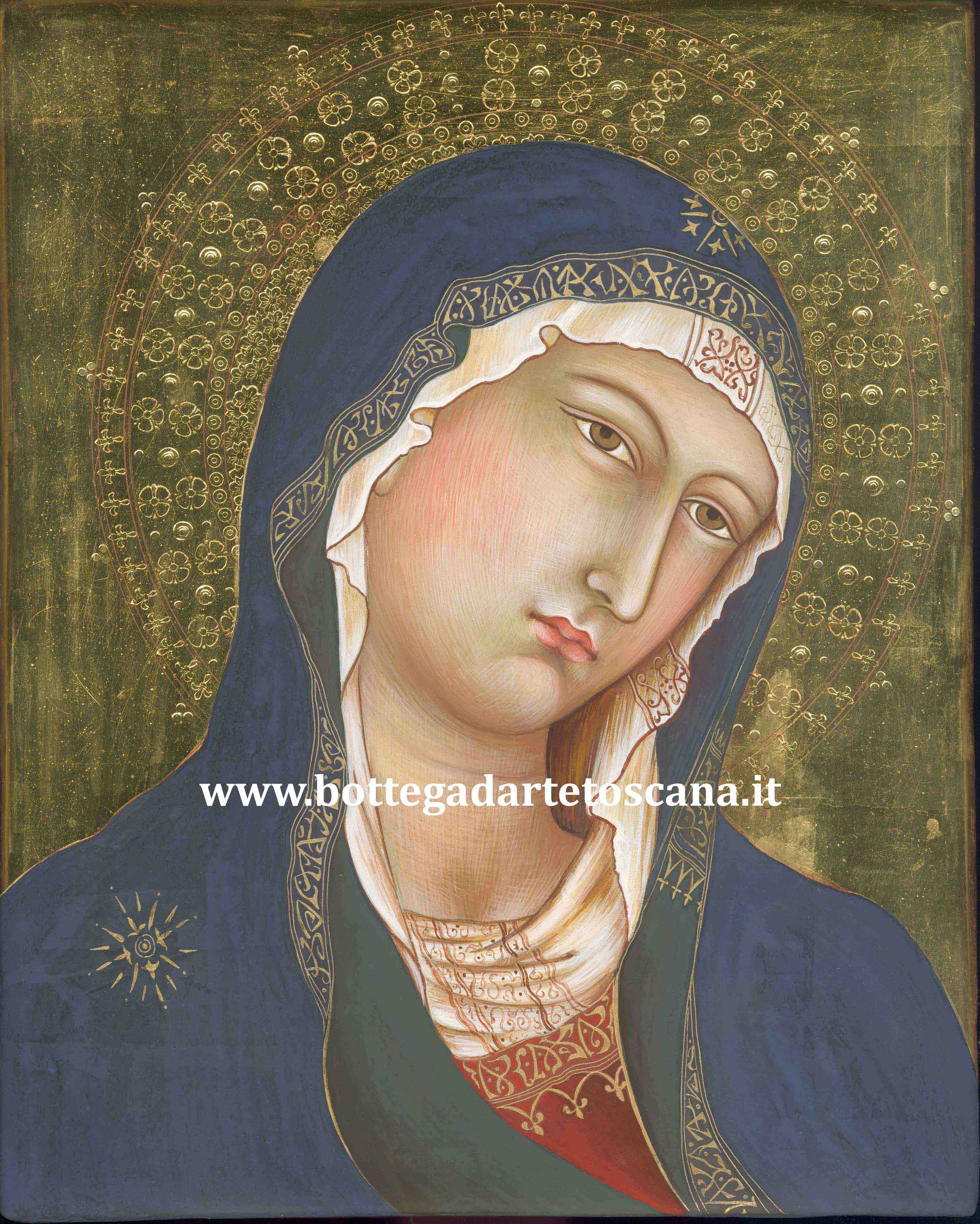
Holy gold tempera icon. Madonna. Icon. Pictorial style study by Simone Martini. Tempera and pure gold on wood. Painting by Silvia Salvadori. Reinterpretation of Simone Martini's painting. Icon of the Madonna (detail of the face) executed on a 23 k pure gold background (pure gold in foil) and painted according to the ancient pictorial recipes used in Tuscany in the 13th and 15th centuries. Careful study of Simone Martini's painting, detail of the complexions and gold decorations.
Tempera and pure gold (23k) on old wood
Pictorial style study by Simone Martini. Madonna. Icon. Pictorial style study by Simone Martini. Tempera and pure gold on wood. Painting by Silvia Salvadori. Reinterpretation of Simone Martini's painting. Icon of the Madonna (detail of the face) executed on a 23 k pure gold background (pure gold in foil) and painted according to the ancient pictorial recipes used in Tuscany in the 13th and 15th centuries. Careful study of Simone Martini's painting, detail of the complexions and gold decorations.
Temptation of Christ on the mountain
Saint Catherine of Alexandria
Off
Sienese Middle Ages
Icon of the Madonna drawn from Simone Martini. Reproduction of Art by Silvia Salvadori.
Sacred icon made with tempera and pure gold on wood.
Work performed with the ancient pictorial techniques of the Sienese school of the fifteenth century.
Original technique painted in egg yolk tempera on a 23 k pure gold background. Decoration on gold carried out entirely in burin. Ancient wooden board.


Icon. Madonna. Simone Martini. Tempera pure gold. Work performed with the ancient pictorial techniques of the Sienese school of the fifteenth century. Sacred icons made with gouache gilding and egg tempera. Sacred icons of Silvia Salvadori reproductions. Ancient recipe book of Cennino Cennini (Book of the Art). Sacred icon, with gouache gilding, pure gold. Detail of the Madonna, Annunciation by Simone Martini.
Tempera and pure gold on an ancient table
Icon. Madonna. Simone Martini. Tempera pure gold. Icon. Madonna. Simone Martini. Tempera pure gold. Sacred icons made with gouache gilding and egg tempera. Sacred icons of Silvia Salvadori reproductions. Ancient recipe book of Cennino Cennini (Book of the Art). Sacred icon, with gouache gilding, pure gold. Detail of the Madonna, Annunciation by Simone Martini.
Annunciation of Duccio di Buoninsegna
Off
Sienese Middle Ages
Guidoriccio da Fogliano at the siege of Montemassi. Reproduction of art by Simone Martini.
Painting made with tempera and pure gold on wood.
Work executed with the ancient pictorial techniques of the Sienese school of the fifteenth century.
Faithful reproduction of the original fresco by Guidoriccio da Fogliano at the siege of Montemassi.
50 x 60 cm


 History:
 Guidoriccio da Fogliano at the siege of Montemassi is a large fresco (968x340 cm) placed in the Sala del Mappamondo of the Public Palace of Siena. The fresco was painted by Simone Martini in 1330. The work shows the commander of Siena's troops, Guido Ricci or Guidoriccio da Fogliano, on horseback, in profile, as he goes to the attack of the Castle of Monte Massi in Maremma in 1328. On the background there is a rather realistic landscape with mountains, a Sienese camp and vineyards.
The painting shows signs of repeated interventions and refinements. Below, within a frame, reads A (N) NO D (OMI) NI M.CCC.XXVIII.
Made by Silvia Salvadori on commission, we notice all the meticulous precision placed in the realization of every detail (mountains, palisade, fitting of the finishes of the finely embroidered Diamond in gold, etc). The sky of an intense deep blue, was painted using a precious blue lapis lazuli.
Siena, Public Palace
Tempera on Gold Leaf 23k
Guidoriccio da Fogliano at the siege of Montemassi. Art reproduction is from a fresco by Simone Martini. Silvia Salvadori, the Art Workshop. Egg tempera painting on wood, original technique Sienese school. Silvia Salvadori Painting
Off
Sienese Middle Ages
Icon of the Archangel Gabriel. Art Reproduction by Duccio di Buonisegna, detail of the face of Archangel Gabriel.
Sacred icon made with tempera and pure gold on wood.
Work executed with the ancient pictorial techniques of the Sienese school of the fifteenth century.
15 x 15 cm


In this painting, Silvia Salvadori wanted to pay homage the great Sienese artist Duccio di Buonisegna performing numerous studies and drawings of the faces of the characters depicted in the great altarpiece, the Majesty of the Duomo of Siena.
The face of the Arcade painted by Silvia Salvadori presents a typical incarnate of the painting of the cousin. Subtle color filaments intertwine in transparency creating delicate shades of color. Great emphasis was given to the decorations of the brocade in gold pluck, obtained with punch and scratch on gold and present throughout the neck. Geometries of pure gold and color make this work a precious jewel. Silvia Salvadori has used the best pigments used in ancient times, among which for this work is a beautiful Afghan blue lapis lazuli of the highest quality.
History:
The Majesty was painted by the Sienese artist for the cathedral of Siena between 1308 and 1311. The work represents the artistic maturity achieved by Duccio and is considered one of the most important paintings of Italian Renaissance art.
The Majesty is currently preserved at the Opera Museum of the Cathedral in Siena. It is a large two-faceted altarpiece (measures 425x212 cm). At the front stand the Virgin Mary and Child on the throne, surrounded by a dense array of angels on a gold background.
The four patron saints of Siena (Sant'Ansano, San Savino, San Crescenzo and San Vittore) are recognized in the foreground, while on the two exterior side there are two Virgin protectors: St. Agnes and St Catherine from Alexandria, painted from sumptuous golden brocade dresses.
Near the Virgin Mary, in the background, we find St. Paul and St. Evangelist on the left, St. John the Baptist and St. Peter on the right. At the top stands a host of winged angels.
On the top we find some stories of the childhood of Christ with the protagonist Virgin Mary and the stories of the Prophets. Many parts have been dismembered over the centuries and some of the survivors can be seen at the National Gallery of London (Annunciation), Washington, National Gallery of Art, New York, Frick Collection (Temptation on the Mount), Madrid , Thyssen-Bornemisza Museum (Meeting with the Samaritan) and other foreign museums.
The fame of this grandiose work is already attested by the chronicles of time depicting a great procession of people in his honor. It is a distinguished civilian and religious character, a symbol of the Sienese people.
The large table was richly decorated in the back and divided into two overlapping bands, where the Passion of Christ is depicted in the twenty-sixth panels, from the Entrance to Jerusalem to the Resurrection. The forefront was represented by steps of the New Testament, the birth of Jesus and the Assumption of the Virgin in Heaven.
In the original work of the great master, there are Byzantine and Gothic elements combined with a unique perfection of details and numerous decorative elements of French taste (brocade dresses).
Museum of the Opera of the Duomo of Siena
Tempera on gold leaf (23k), antique table
Off
Sienese Middle Ages
Annunciation of Duccio di Buoninsegna. Author's copy of Silvia Salvadori.
Sacred icon made with tempera and pure gold leaf on wood.
Work performed with the ancient pictorial techniques of the Sienese school of the fifteenth century.
30 x 40 cm


Work drawn from: Duccio di Buoninsegna, XIV century. Work performed with the ancient pictorial techniques of the Sienese school of the fifteenth century. Technique: tempera and gold on wood. ART REPRODUCTION by Duccio di Buoninsegna (copyright copy by Silvia Salvadori). Icon, Annunciation on a gold background. Hand painted sacred icon. Medieval painting. Icon, art reproduction by Duccio di Buoninsegna. Reinterpretation of the icon of the Annunciation by Duccio di Buoninsegna. Predella of the Annunciation of the Polyptych of the Majesty by Duccio di Buoninsegna, Siena. History of the painting: The icon of the Annunciation is an autographed painting by Duccio di Buoninsegna belonging to the predella della Maestà of the Siena Cathedral, made with tempera and pure gold on panel in 1308-11, measuring 43 x 44 cm. and is kept in the National Gallery in London. The icon of the Annunciation by Duccio di Buoninsegna is often mentioned by ancient sources, it was purchased in the nineteenth century in the city of Florence. What has made scholars more discuss, is that pot-bellied vase containing lilies with - in itself - multiple perspective curves, which most critics agree in considering these curves the fruit a firm will of the artist: an annotation in the perspective solution, validated by the poetic quality of the evocation. It should be remembered that, with regard to this topic, there is (or existed) an icon of the Annunciation by Duccio di Buoninsegna often cited by scholars, who say it was commissioned by the church of Santa Trinità in Florence.
National Gallery, London
Tempera on a pure gold background on an ancient table. Gold engravings.
Tempera and pure gold on an ancient table. Reinterpretation of the icon of the Annunciation by Duccio di Buoninsegna. Hand painted sacred icon
Off
Sienese Middle Ages
Subscribe to Sienese Middle Ages





